

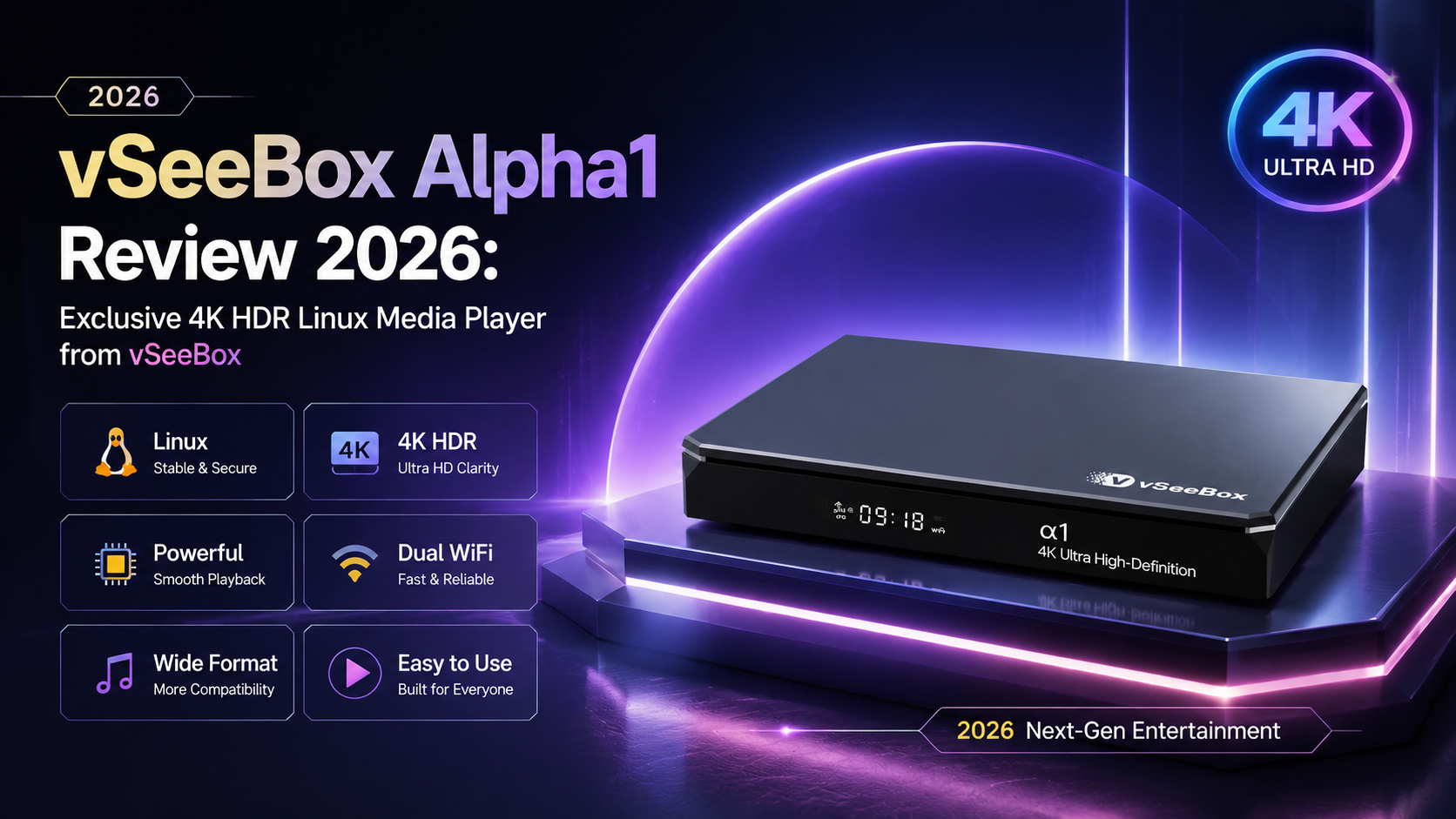
The vSeeBox Alpha1 brings something different to the vSeeBox lineup. Instead of focusing on an Android-based experience with a large number of smart features, the Alpha1 uses a lightweight Linux system and puts the emphasis on smooth video playback, stability, and easy everyday operation.
For buyers who mainly want a straightforward device for enjoying 4K entertainment, the Alpha1 is an interesting alternative to the vSeeBox V6 Series.
In this guide, we'll take a closer look at its specifications, key features, ideal users, and how it compares with Android-based vSeeBox models.
vSeeBox Alpha1 Specifications
| Feature | vSeeBox Alpha1 |
|---|---|
| Operating System | Linux 4.9 |
| Processor | Quad-Core ARM Cortex-A35 |
| Maximum Video Output | 4K @ 60fps |
| HDMI | HDMI 2.1 |
| Video Decoding | AV1, VP9, H.265, H.264 10-bit HDR |
| Wi-Fi | Dual-Band 2.4GHz / 5GHz |
| Main Focus | Stable and simple 4K media playback |
The hardware and software combination is designed around efficient media playback rather than adding unnecessary complexity.
What Makes the vSeeBox Alpha1 Different?
The biggest difference between the Alpha1 and most recent vSeeBox models is the operating system.
While models such as the V6 Plus and other V6 Series devices use Android, the Alpha1 runs Linux 4.9.
That gives the Alpha1 a different personality. Instead of trying to provide the widest possible range of smart features, it focuses on three things:
- Smooth 4K playback
- Stable daily performance
- Simple operation
For users who don't need a complicated interface or extensive multitasking features, that simplicity can actually be an advantage.
4K HDR Playback with HDMI 2.1
The Alpha1 supports HDMI 2.1 video output with resolutions up to 4K at 60fps.
That makes it suitable for modern 4K televisions and home entertainment setups where smooth motion and high-resolution video are important.
If you are upgrading from an older media player limited to lower resolutions or frame rates, the Alpha1 provides a more modern video output platform.
Support for Modern Video Formats
Another strong point is codec compatibility.
The vSeeBox Alpha1 supports decoding for:
- AV1
- VP9
- H.265
- H.264
- 10-bit HDR video
Support for these modern formats gives the Alpha1 better compatibility with today's high-quality digital video content.
AV1 and H.265 in particular are commonly used to deliver high-resolution video more efficiently, making codec support an important consideration when choosing a newer media player.
Linux-Based Performance
Instead of Android, the Alpha1 runs Linux 4.9.
A lightweight operating system can be particularly useful in a media player because the device can focus more of its resources on its primary functions.
The Alpha1 is therefore aimed less at users who want to customize everything and more at people who want to turn on their TV, access their entertainment, and start watching.
For families and less technical users, this straightforward approach may also make everyday operation easier.
Dual-Band Wi-Fi Connectivity
The Alpha1 supports both 2.4GHz and 5GHz Wi-Fi, along with MIMO wireless technology.
The two Wi-Fi bands serve slightly different purposes:
2.4GHz generally offers better range and can be useful when the media player is farther away from the router.
5GHz can offer faster wireless performance over shorter distances and is often preferable for high-quality video streaming when the Wi-Fi signal is strong.
Having access to both gives users more flexibility depending on their home network setup.
Who Is the vSeeBox Alpha1 Best For?
The Alpha1 should appeal most to users who value simplicity over having the maximum number of features.
It is particularly suitable if you:
- Want a straightforward 4K media player
- Prefer a Linux-based device
- Value system stability and easy operation
- Mostly use your device for watching entertainment
- Want support for modern video codecs
- Don't need extensive Android features or multitasking
It can also be a good fit for a living room, bedroom, or secondary TV where a simple entertainment setup is more important than advanced customization.
vSeeBox Alpha1 vs vSeeBox V6 Series
The Alpha1 and V6 Series are not necessarily competing for exactly the same type of buyer.
| Feature | vSeeBox Alpha1 | vSeeBox V6 Series |
| Operating System | Linux | Android |
| Main Purpose | Simple media playback | More feature-rich entertainment |
| User Experience | Straightforward | More flexible |
| Multitasking | Basic | More advanced |
| Best For | Simplicity and stability | Users who want more features |
The most important difference is therefore not simply hardware performance. It is how you want to use the device.
Choose the Alpha1 if:
You mainly want a dependable media player, prefer a clean and straightforward experience, and don't need a large collection of additional smart-TV features.
Choose a V6 Series model if:
You prefer Android, want additional functionality, use more apps, or want a more flexible entertainment platform.
Alpha1 vs V6 Plus: Which Is Better?
There isn't one answer that works for everyone.
The Alpha1 makes more sense for someone who wants:
- Linux
- Simple operation
- Smooth 4K playback
- Fewer unnecessary features
The V6 Plus makes more sense for someone who wants:
- Android
- More entertainment functions
- Greater flexibility
- Additional system features and multitasking
Think of the Alpha1 as the more focused option, while the V6 Plus is the more feature-oriented option.
Is the vSeeBox Alpha1 Worth Buying in 2026?
For the right type of user, yes.
The appeal of the Alpha1 isn't that it tries to offer more features than every other vSeeBox. Its strength is that it takes a simpler approach.
You get:
- Linux-based operation
- 4K@60fps output
- HDMI 2.1
- HDR support
- Modern video codec compatibility
- Dual-band Wi-Fi
- A straightforward user experience
If your priority is a practical media player for everyday entertainment rather than a highly customizable Android device, the Alpha1 is worth considering.
What Should You Check Before Buying?
As with any media player, it's worth checking a few things before ordering:
- Product model and specifications
- Warranty coverage
- Shipping time
- Return policy
- Customer support
- Seller reputation
- After-sales technical assistance
Buying from a reliable seller can be especially useful if you need help with installation, setup, troubleshooting, or warranty service later.
Frequently Asked Questions
What operating system does the vSeeBox Alpha1 use?
The vSeeBox Alpha1 runs Linux 4.9. It is designed around a lightweight and straightforward media playback experience.
Does the vSeeBox Alpha1 support 4K?
Yes. It supports video output of up to 4K at 60fps through HDMI 2.1.
Does Alpha1 support HDR?
Yes. The Alpha1 supports 10-bit HDR video decoding along with several modern video formats.
Which video codecs does Alpha1 support?
Supported formats include AV1, VP9, H.265, and H.264, along with 10-bit HDR decoding.
Does the Alpha1 support 5GHz Wi-Fi?
Yes. It supports dual-band 2.4GHz and 5GHz Wi-Fi.
Is Alpha1 an Android TV box?
No. One of the most important differences is that the Alpha1 uses Linux rather than Android.
Is the Alpha1 better than the vSeeBox V6 Plus?
It depends on what you want.
The Alpha1 is better suited to users who prefer a simple Linux-based media player focused on stable 4K entertainment.
The V6 Plus is better suited to users who prefer Android and want more features, flexibility, and multitasking options.
Who should buy the vSeeBox Alpha1?
It is a good option for people who primarily want reliable 4K entertainment and prefer simple operation rather than a feature-heavy smart TV experience.
Final Thoughts
The vSeeBox Alpha1 takes a different approach from the Android-based V6 lineup.
Instead of competing by adding more and more features, it focuses on what many users actually need from a media player: easy operation, stable performance, modern video support, and smooth 4K playback.
If those are your priorities, the Alpha1 is a compelling option to consider in 2026. For users who want a broader Android experience with more advanced features, one of the V6 Series models may still be the better fit.